


Wout Schotte stunts with European title in his division
 31 May 2025
Team Belgium gave it their all this past weekend at the 4th edition of the European Championship.
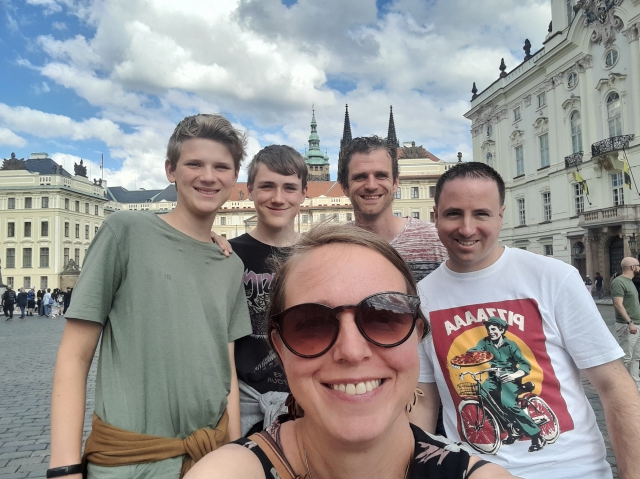
Tom Schotte, Ralph Reijnders, Nadja De Moor, Wout Schotte, and Sander Schotte traveled to the Czech capital, Prague, for a record-setting edition of this still-young event. No fewer than 87 players from 16 different countries took part.
The Belgian delegation set off with varied expectations. None were aiming for a top-four finish or the open European title, but several side categories made the tournament interesting. For Tom Schotte, that didn’t matter—he played in the Open class (seeded 19th) and was not eligible for any other category. Ralph Reijnders competed in Division I (seeded 12th out of 21 players), Nadja De Moor—last year's Division III European Champion—now had to compete in Division II (7th seed out of 11 players), while Wout and Sander Schotte played in Division IV (3rd and 17th seeds out of 17 players). In each division, a top-four placement was required to reach the semi-finals on Sunday.
Additionally, there were four other categories: Belgium had no representatives in the U12 juniors or 60+ seniors, but did compete in the U18 juniors (Wout and Sander Schotte, seeded 6th and 9th out of 10 players) and in the women’s category (Nadja De Moor, 3rd out of 14 players), all aiming for a top-three finish. In these categories, the tournament ended after 11 rounds and the top three received trophies.
Switzerland on Top
For the top players, a lot was on the line—including a ticket to the World Championship later this year. This extra spot was very welcome for countries with strong players. Favorites included the winners of the previous two editions: Makoto Suekuni (a Japanese player representing the Netherlands) and Michele Borassi (an Italian representing Switzerland). Last year's runner-up, Oskar Eklund (a Swede representing Sweden—yes, it can happen), was joined by his countryman Niklas Wettergren. Also among the (dark horse) favorites were Arthur Juigner (French/Swiss, representing Switzerland), Matthias Berg (German, playing for Switzerland), Dominik Nowak (Poland), and Lari Pihlajapuro (Finland).
After five rounds, two Swiss players were in the lead: Arthur Juigner and Matthias Berg. Juigner had already defeated Makoto Suekuni (23–41), while Berg stopped the strong performance of Marc Tastet (25–39). Two players remained unbeaten: Czech top player Miroslav Voracek and Poland’s Pawel Peczkowski, both on 4.5/5, just ahead of a large group at 4 points (including all other favorites, except Niklas Wettergren, who had already faced top opponents Makoto Suekuni and Dominik Nowak—and lost).
Matthias Berg surged to seven points by the end of Day 1, followed closely by Tastet, Suekuni, Juigner, and Pihlajapuro, all with six points. Pawel Peczkowski and Roel Hobo were close behind with 5.5, and eleven others with five points still had a shot at the European title. The other 67 players were effectively out of the race, since nine (maybe even ten) points were needed for a top-two finish and a place in the final.
Day 2 began with increased tension. Makoto Suekuni beat Matthias Berg (23–41), and Arthur Juigner won against Tastet (46–18). Because Lari Pihlajapuro lost to Pawel Peczkowski (36–28), three players were suddenly tied for the lead. The tie-break was separated by just eight discs. Would another player break the deadlock, or would all three finish on 10/11? That was ruled out when Lari Pihlajapuro defeated Berg just before the finish (44–20). Or was it? In round 10, Michele Borassi defeated Makoto Suekuni (37–27), leaving four players with eight points from ten games—one match away from the final. Juigner wasn't safe yet, only narrowly ahead on tie-break.
The eleventh and final round had to decide everything. Juigner secured his final spot against Pihlajapuro (26–38), who still made it to the playoff. Suekuni did what he had to do by beating Peczkowski (41–23). The most intriguing game was Berg vs. Borassi. Borassi, needing a big win due to a weak tie-break, took risks—but blundered in a winning endgame, allowing Berg to win (21–43). This sizable win left Suekuni three discs short of a spot in the final, relegating him to the third-place playoff.
The final was tense but controlled, with Arthur Juigner winning 2-1 (28–36, 29–35, 27–37). Makoto Suekuni won the playoff against Lari Pihlajapuro (34–30).
In the other categories, the winners were: Katie Pihlajapuro (Women), Imre Leader (Seniors), Daniel Dufour (U18 Juniors), Sanna Zillig (U12 Juniors). These were not surprises. The division winners were: Daniel Rossler (Division I), Michal Buka (Division II), Pawel Noga (Division III) and our own Wout Schotte (Division IV)
The Belgians
The Belgian players had a solid tournament, with no major highlights but also very few losses to lower-ranked opponents.Tom Schotte finished with 6/11, tied for 26th. He won all four games against lower seeds and scored two out of seven against stronger players. He played a strong game against Michele Borassi (31–33 loss), where the final 20 moves were a perfect endgame. He lost his last two games, missing out on a tie for 13th place.
Ralph Reijnders scored 5.5/11, tied for 43rd. He did little wrong, but was likely disappointed by a draw against lower-seeded Karel Cervenka in round ten. A loss to Michael Margaliot in round five was also unfortunate, though he did beat British player Ian Turner.
Nadja De Moor ended on 5/11, tied for 47th. She defeated higher-seeded players like Pavel Cervenka and Erik Johansson. Her narrow loss to Nikita Zincenko in round ten (31–33) was the only blemish. She finished fourth among women—just missing the podium and a trophy.
Wout Schotte finished tied for 67th with four points. He lost to lower-seeded Marco Bosco, but the rest of his games reflected his seeding. That was still enough to qualify third for the Division IV semifinals. He defeated Finland’s Coby Pihlajapuro (23–41) in the semifinal, setting up a final against Lithuania’s Vlad Juodele. Importantly, Juodele got to choose color and opted for black, meaning Wout got his favorite—white. With this choice, Wout only needed a draw to win. Juodele could have aimed for a draw too, but didn’t. The final wasn’t promising early on—Wout made several poor moves. But Juodele couldn’t completely shut down the game, allowing Wout to slowly recover. In a tense endgame, Wout was trailing 50–6 with just eight moves left but clawed back to a 32–32 draw. Thanks to the color choice, that tie gave him the Division IV European title!
Sander Schotte finished with three points, tied for 80th. As the lowest-seeded player, he still managed to beat two higher-ranked opponents: Adam Hlavac and Jana Neuzilova. His third point came from a bye.
The European Championship is highly recommended: You get to compete in a tournament with players from many countries and all skill levels—and you can turn it into a great city trip!
We hope to see even more Belgians at next year’s European Championship. The location of the next Othello European Championship is not yet known, but we’ll keep you posted as soon as we hear more!